


From Drawing to Plant
CYP ENGY: logistics packaging and industrial process engineering
We design the logistics packaging for each part, from analysing the part to series production, so that it travels protected, takes up less space and reaches the line in sequence. And we define the logistics process it works in.
- Speciality
- Industrial process engineering
- Team
- More than 55 people
- Tools
- Siemens NX · CATIA V5 · SolidWorks · MicroStation · HLS
Every container starts with the part.
We analyse the part and design in 3D the container that carries it: how it is held, how it is loaded and how many fit. Here are five of ours: pick one, turn it and take it apart.
A container designed by CYP ENGY, drawn part by part. Drag it to turn it, use the wheel or the buttons to zoom, right-drag to move it and «Take apart» to separate its groups. The phases beside it change the drawing.
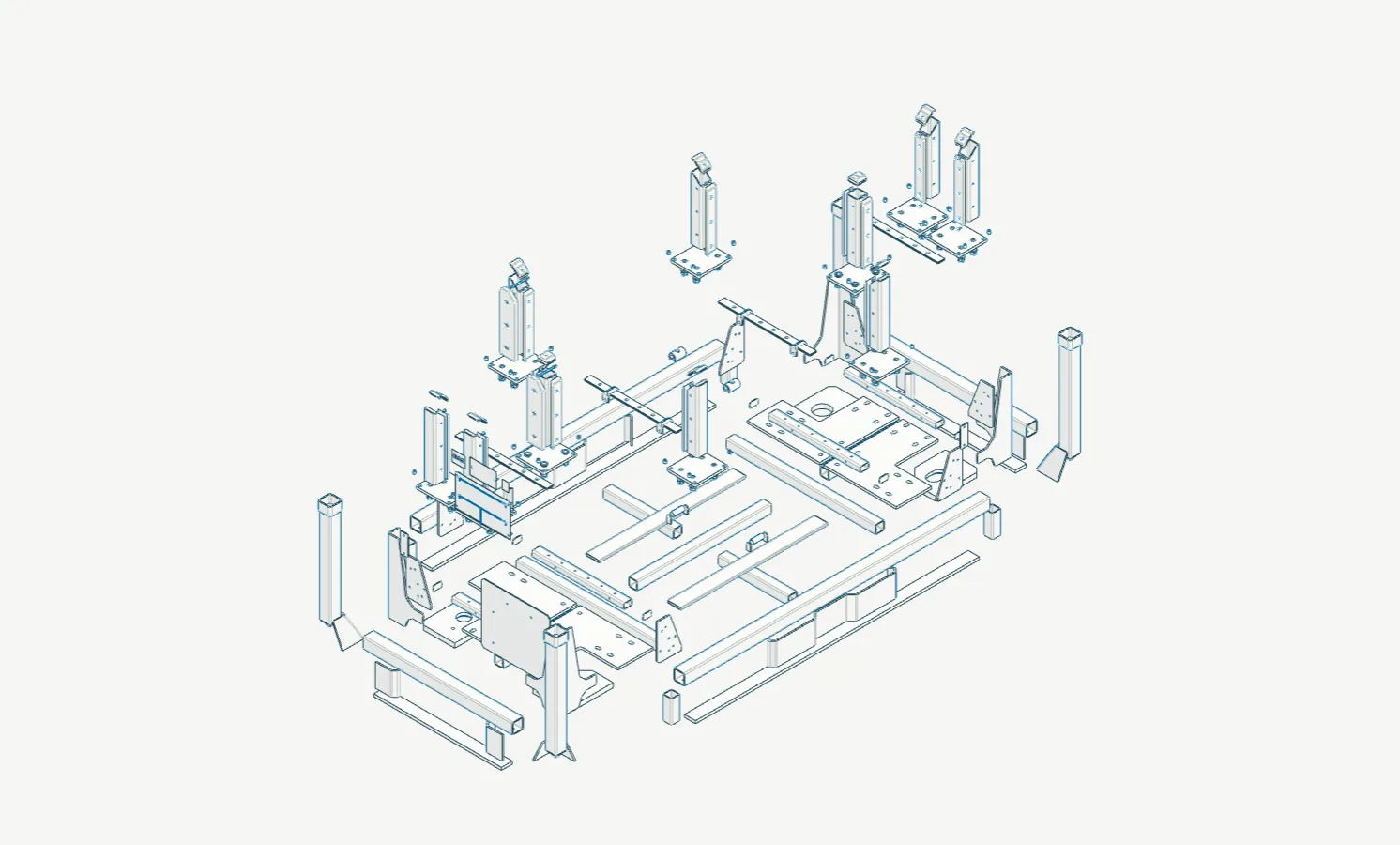
Drag to turn it · scroll to zoom · right-drag to move it
Container with supports 0.79 × 1.5 × 0.54 m 464 placed parts · 56 distinct Siemens NX
Logistics container 2.4 × 1.9 × 0.73 m 227 placed parts · 59 distinct Siemens NX
Long container 3.38 × 0.88 × 0.52 m 266 placed parts · 64 distinct Siemens NX
Container for AGVs 1.2 × 1.2 × 1 m 2,284 placed parts · 308 distinct CATIA V5
Cart with compartments 1.23 × 2.16 × 1.72 m 278 placed parts · 60 distinct Siemens NX
From the part to the series
From analysing the part to series production, with the planner and the client’s departments at every decision.
-
We gather the part and what it needs: quality, ergonomics, industrialisation and logistics, and the containers it has to share the flow with.
-
We sketch ideas and compare them by cost, transport savings, carbon footprint and ergonomics, with the planner.
-
We design the chosen concept in 3D, in Siemens NX, CATIA V5 or SolidWorks, validate it with every department at the client and write its technical specification: material, components, quantity and deadlines.
-
We review the manufacturing offers technically and check that the manufacturer can make what it offers.
-
We review the prototype and coordinate the transport and supply tests and the approval in the plant: the check that it works.
-
We review the pre-series and the series, and follow the manufacturer and the part suppliers up to each delivery, with its delivery note.
What it is designed for
-
Protect the part
So that it reaches the line undamaged, whatever the journey.
-
Make every load count
More parts per container and less empty volume in the truck and the warehouse.
-
Fit into the process
A design aligned with every requirement and constraint of the production process.
-
Handle without strain
Loading and unloading designed for the operator and the workstation.
- Materials
- Metal, plastic, EPP, thermoformed, plastic injection and ESD treatment
- Loading
- Automatic, semi-automatic and manual
Engineering that ends on the line.
The container is one part of the flow. We also design the flow: how the part gets from the supplier to the line, where it is stored, how it is prepared and how the empty returns, and we write the specifications for whoever runs it.
-
From the supplier to the plant, the container travels full and protected, with a clear specification for whoever carries it.
- Specifications for logistics operators
- Offer comparison
- Better packaging cube
- Dock capacity and time windows
-
Where and how each part is stored, and with what equipment.
- Storage layout
- Equipment specifications: racking, C-frames and platforms
- Racking roll-out and follow-up
- Logistics zone moves and automated warehouses
-
Picking, kitting and sequencing: the part leaves the warehouse in the order the line asks for.
- Picking, kitting and sequencing zones
- Picking routes
- Sequence carts
-
How each part reaches its workstation, when it is due to be fitted.
- Better line-side supply
- Automated supply with AGVs and automatic transport systems: initial study, routes and fleet
- Coordinating the suppliers through start-up, in body, assembly and battery shops
- Aisle saturation and supply routes
-
The line and its workstations, ready for each new model.
- Line and layout configuration for new models
- Takt sizing and material allocation per workstation
-
The empty container goes back to the supplier for its next trip.
- Returning containers to the supplier
- Optimising return flows
-
What orders the whole flow: the processes and the systems that call parts off.
- Logistics process definition
- Specifications for system roll-outs: automatic call-offs and logistics SAP
- Process analysis and improvement
- Process optimisation and PMO
How we do it
-
Analyse
We analyse the process, the layout, the packaging cube and line-side supply to see what to improve.
-
Define
We define the logistics processes and the storage layout.
-
Specify
We write the specifications: for logistics operators, for equipment such as racking and platforms, and for systems such as automatic call-offs or logistics SAP.
-
Compare offers
We compare the offers made against each specification.
-
Implement and follow up
We implement what was defined, such as racking, and follow it up.
Projects in the plant.
AGV supply, packaging for launches, unified lines and continuous improvement, in automotive plants.

-
SEAT Martorell: more than 600 containers developed for new model launches
Design, management and follow-up of part-specific packaging for new Volkswagen Group model launches at the Martorell plant.
100 sequence carts developed
-
SEAT Martorell: seat supply to the line automated with AGVs
AGV-based automation of seat supply to the line for the new SEAT León and CUPRA Formentor, ensuring a continuous flow from the marquee to the point of consumption.
-
SEAT Martorell: 2 assembly lines unified for the SmallBev launch
Reconfiguration of assembly lines at SEAT Martorell to adapt them to new models, optimizing logistics flows and space usage through 3P workshops.
66 of 135 high-turnover part numbers, with automation potential

-
Audi Brussels: 40% of the annual savings target consolidated with the OLB methodology
Logistics process optimization at Audi's Brussels plant with the OLB method: container savings and automation trials using under-used AGVs.
2 AGV automation proofs of concept
Tell us about your plant.
Which line, packaging or supply flow you want to change, and by when. An engineer from CYP ENGY reviews your case.